

Every product has two laboratories: development and the real world. The real world finds what the lab never imagined. The Feedback module of the Nyverra ITSM Portal exists to capture this finding — before it becomes silent dissatisfaction.
This guide explains what the module receives, how status is tracked, and why a well-operated feedback channel is a lever for continuous improvement.
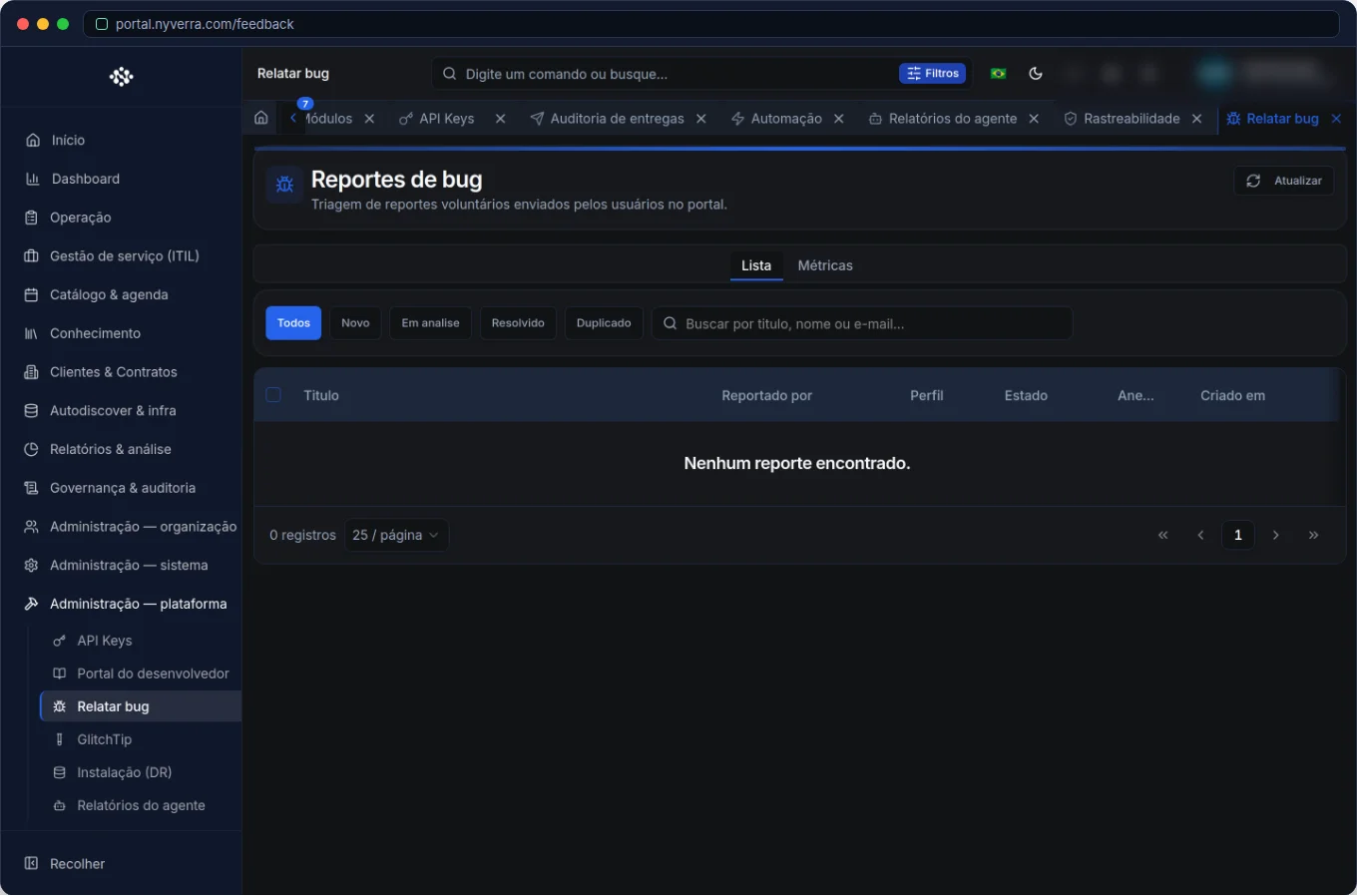 Module interface in Nyverra ITSM Portal.
What the Feedback module captures
It is the official channel for the user to report product issues and propose improvements — distinct from IT service requests:
| Type | Example |
|---|---|
| Bug report | “Filter X doesn't save the preference.” |
| Improvement suggestion | “It would be useful to export list Y to CSV.” |
| Usage feedback | “Flow Z could have fewer clicks.” |
The key point: separate product bugs from IT incidents. The first goes to the product backlog; the second, to the service desk.
Why a feedback channel matters
- Early detection: real problems appear before they escalate.
- Data-driven prioritization: volume/recurrence of feedback guides the roadmap.
- Engagement: those who give feedback and receive a response start participating in the evolution.
- Perceived quality: closing the loop (“we resolved it”) improves trust in the product.
Who uses it
| Profile | Typical use |
|---|---|
| User | Registers bug/suggestion |
| Product team | Triages, classifies, and prioritizes |
| Administrator | Monitors the flow and notifications |
How to use: step by step
- The user registers the feedback with description and context.
- The team triages and classifies (bug? suggestion? duplicate?).
- The status is updated (under analysis, planned, resolved, not applicable).
- The response is communicated to the author.
- The items feed the roadmap prioritization.
Business rules and cautions
| Point | Explanation |
|---|---|
| Bugs vs incidents | Product bug ≠ IT incident; each has its own flow. |
| Duplicity | Group similar feedback to measure real impact. |
| Response | Replying, even when it won't be done, closes the loop. |
| Privacy | Context and attachments may contain data; handle according to LGPD. |
Good practices
- Always respond — including negatives (“won't be done now”), with the reason.
- Group similar feedback; recurrence is a sign of priority.
- Clearly separate product bugs and IT incidents.
- Use feedback volume to prioritize the roadmap with data.
- Close the loop: inform when an item has been resolved.
Common mistakes
| Situation | What to do |
|---|---|
| Unanswered feedback | Disengages the user; create a routine for response and status. |
| Bug treated as an incident | Route to the product backlog. |
| Ignoring recurrence | Group and prioritize what repeats. |
Frequently asked questions
Does feedback replace service requests?
No — they are different flows: product bug vs IT incident.
Does the user see the status?
Yes, status tracking is part of the module.
Is it used to prioritize the roadmap?
Yes, feedback volume/recurrence guides prioritization.
Automate via API
The module is exposed via API (/api/feedback and related), allowing the channel to be integrated with product tools. Reference at developer.nyverra.com.
Use cases: the improvement cycle in action
1. Bug reported, fixed, and communicated. The user reports a filter error; the team fixes it and notifies. The user realizes their contribution mattered — and starts reporting more.
2. Suggestion that becomes a feature. Several users ask to export a list to CSV. Feedback volume signals demand; the feature enters the roadmap with justification.
3. Reduction of support tickets. Separating “product bug” from “usage question” prevents support from becoming a dumping ground for reports that should go to the product — and vice versa.
KPIs of a healthy feedback channel
| Indicator | What it reveals |
|---|---|
| Feedback received per period | User engagement |
| % with updated status | Whether the channel is taken seriously |
| Time to first response | Team responsiveness |
| Bugs vs suggestions | Nature of demand |
| Recurrence of themes | Roadmap priority |
Closing the loop
The value of feedback is less in receiving it and more in responding. Even a “won't be done now, and the reason is X” keeps the user engaged. A channel without response dies silently — and with it dies continuous improvement. With triage, status, and response, the Nyverra ITSM Portal transforms user perception into product direction.
Feedback channel checklist
- Define what is a bug vs IT incident.
- Establish triage and status.
- Commit to responding to the author.
- Group recurring themes.
- Use volume to prioritize the roadmap.
- Communicate when an item is resolved.
Additional frequently asked questions
What if it won't be implemented?
Respond anyway, with the reason — maintains engagement.
How to prioritize?
By recurrence and impact of the theme.
Are feedback and support the same queue?
No; product bug goes to the product, incident goes to the service desk.
Conclusion
With the Feedback module, the Nyverra ITSM Portal evolves together with those who use it. A channel that captures, prioritizes, and responds closes the continuous improvement loop — and transforms user perception into product direction.
Keep reading
Read also

StorCLI - Complete Cheat Sheet
StorCLI is the official and modern tool for managing Broadcom/LSI RAID controllers. This guide covers essential commands, syntax and use cases.
12 min de leitura Tutoriais
Business Services in Nyverra Portal: Translating IT into Business
The business doesn't feel a server go down — it feels email stop. The Business Services (Service Mapping) module of Nyverra ITSM Portal connects services like Email, ERP or PACS to CMDB assets, revealing the real impact of each failure.
5 min de leitura Segurança
RPO vs RTO: How to Define Before Buying Backup (and Why Most Companies Get It Wrong)
Most companies buy backup asking the wrong question: "how much does it cost?". The right question is: how much data can I lose (RPO) and how long can I be down (RTO). Discover how to define these numbers per system and avoid purchasing protection based on price, not on real need.
9 min de leitura
Comments
No comments yet
Be the first to share your thoughts on this article.


Leave a comment